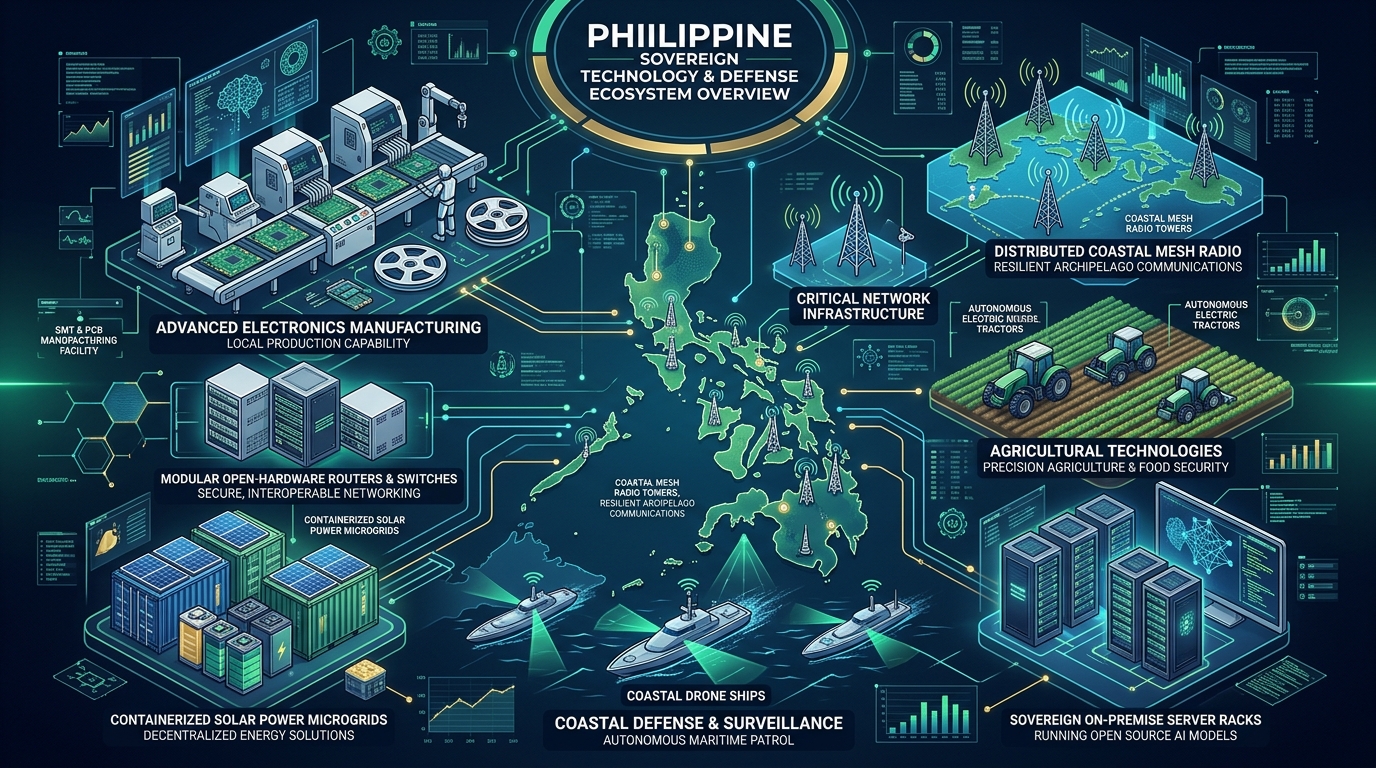
Why the Status Quo Clings to Vendor Capture
Enterprise and government buyers fear departing from proprietary foreign vendors because change involves real organizational friction and perceived capital expenditure risk. Buying Cisco or Microsoft feels safe—until an embargo, a license price surge, or an archipelagic infrastructure outage cuts off the cord.
Proprietary Lock-in
Recurring foreign software rents and proprietary silicon enforce permanent dependency. Organizations become unable to service, inspect, or audit their own critical infrastructure.
Service-Level Competition
Open hardware and auditable software mean the customer owns their destiny. We earn revenue by maintaining high-availability SLAs, rapid repairs, and custom Philippine adaptations.
Auditable Silicon
Mainline Linux drivers and open PCB schematics eliminate telemetry backdoors and undocumented proprietary blobs. Hardware can be verified down to the trace.
Local Economic Capital
Capital spent on foreign licenses vanishes overseas. Capital spent on open-source solutions employs Filipino engineers, fabricators, and network specialists across all 17 regions.
Electronics Manufacturing: The Precision Triangle (SK, TW, JP)
A country does not need a multi-billion-dollar silicon wafer foundry to achieve hardware sovereignty. The strategic choke point is Surface-Mount Technology (SMT) and Board-Level Pick-and-Place (PnP).
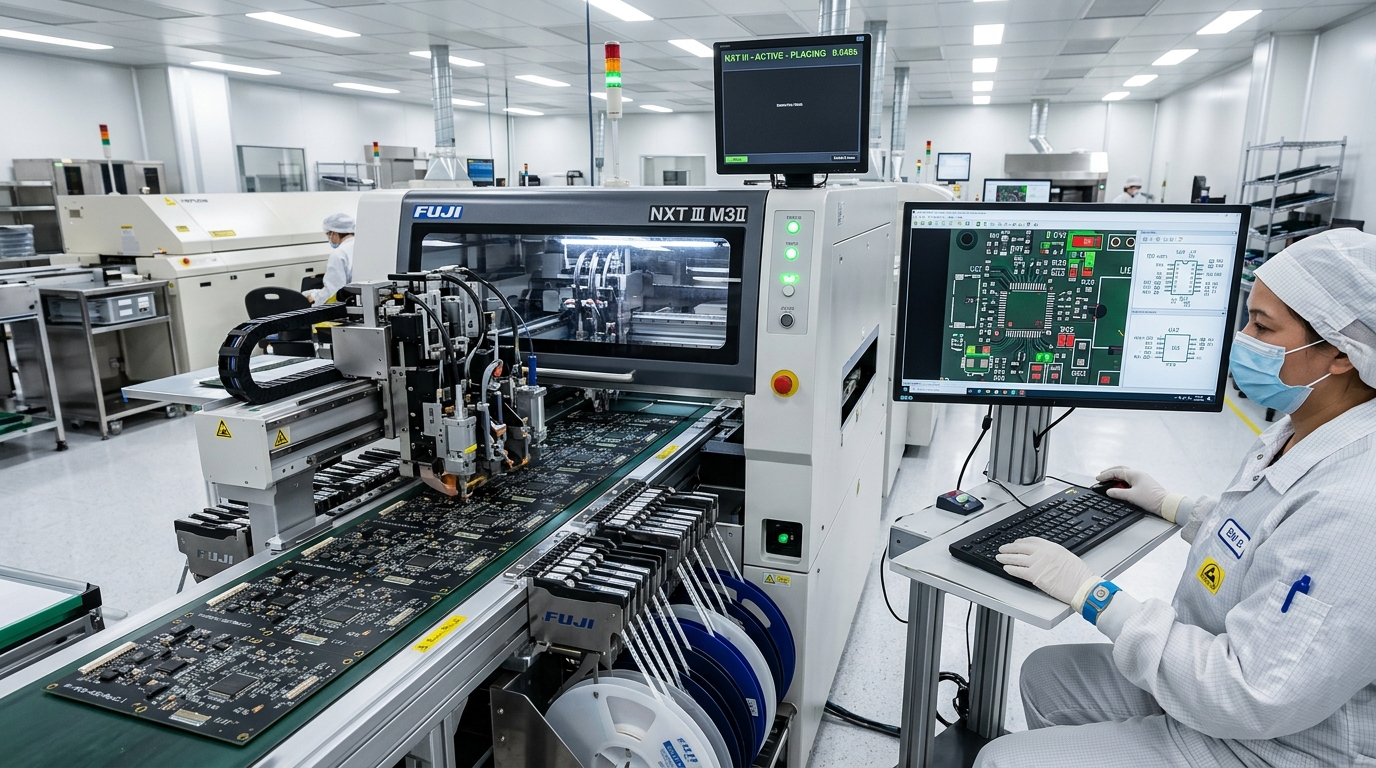
Gold-standard placement accuracy, high-reliability component feeders, and thermal-stable reflow technology capable of placing 0201 passives and fine-pitch QFN/BGA packages.
Agile, high-speed SMT assembly platforms offering exceptional cost-to-throughput ratios, rapid reel changeover, and robust feeder support for batch hardware fabrication.
Precision automated optical inspection (AOI), stencil fabrication, in-circuit test (ICT) jigs, and rapid turnaround multi-layer substrate supply.
Project Balangay: The Open Router, Firewall & Switch
Repurposing Bryan Tech's open-source laptop (byrantech/anyon_e, BetterGov.ph #409) into a ruggedized, modular networking appliance engineered for Philippine schools, barangay health clinics, and archipelagic defense outposts.
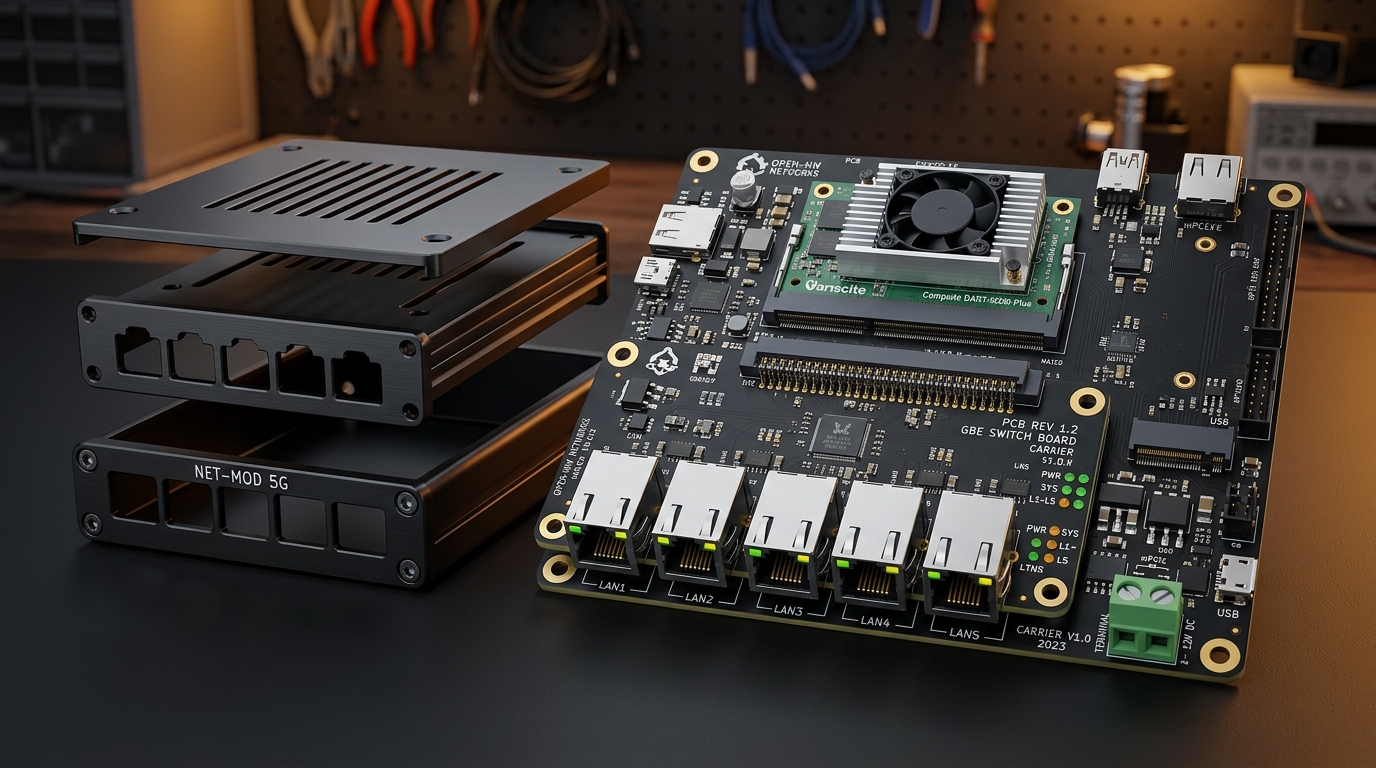
Standalone Managed Switch
A self-contained 4-layer switch PCB featuring 5× RJ45 jacks with integrated magnetics (inspired by the open BotBlox KSZ8895 pattern). Driven by a mainline Linux DSA switch IC (Microchip KSZ9897 or Realtek RTL8365MB).
- Ports: 5× Gigabit Ethernet with integrated magnetics
- Power: 12V DC wide-input terminal block
- Stacking: High-density header exposing the RGMII/SGMII MAC uplink
- Phase 1 Gate: Ships and sells alone as a low-cost managed switch
Firewall & Compute Carrier
A 6-layer carrier board hosting the FriendlyELEC CM3588 (Rockchip RK3588, 8–16 GB LPDDR4x, 6 TOPS NPU). Inherits connector footprints and power trees from Bryan Tech's laptop while eliminating consumer battery and display circuits.
- Compute: Rockchip RK3588 8-core SoC via 4× 100-pin connectors
- Expansion: 1–2× M.2 slots (NVMe logging or 4G/5G LTE modem)
- Subsystems: ESP32 watchdog MCU, thermal fan header, USB serial console
- Network Uplink: Dedicated MAC link down to Board A via stacking bus
The Software Reality: OpenWrt & VyOS over pfSense/OPNsense
A core principle of Project Balangay is intellectual honesty: this appliance will not run OPNsense or pfSense. OPNsense is strictly x86-64, and pfSense CE discontinued ARM support. Pretending otherwise wastes engineering hours. Instead, we run OpenWrt, VyOS, or Debian + nftables.
National Mesh: Operational Security for Philippine Defense
Centralized subsea cable landings and telco backbones present a fatal vulnerability: a single point of failure (an "Internet Kill Switch"). The National Mesh federates regional wireless and fiber bridges, granting un-severable communications depth for civil and military operations.
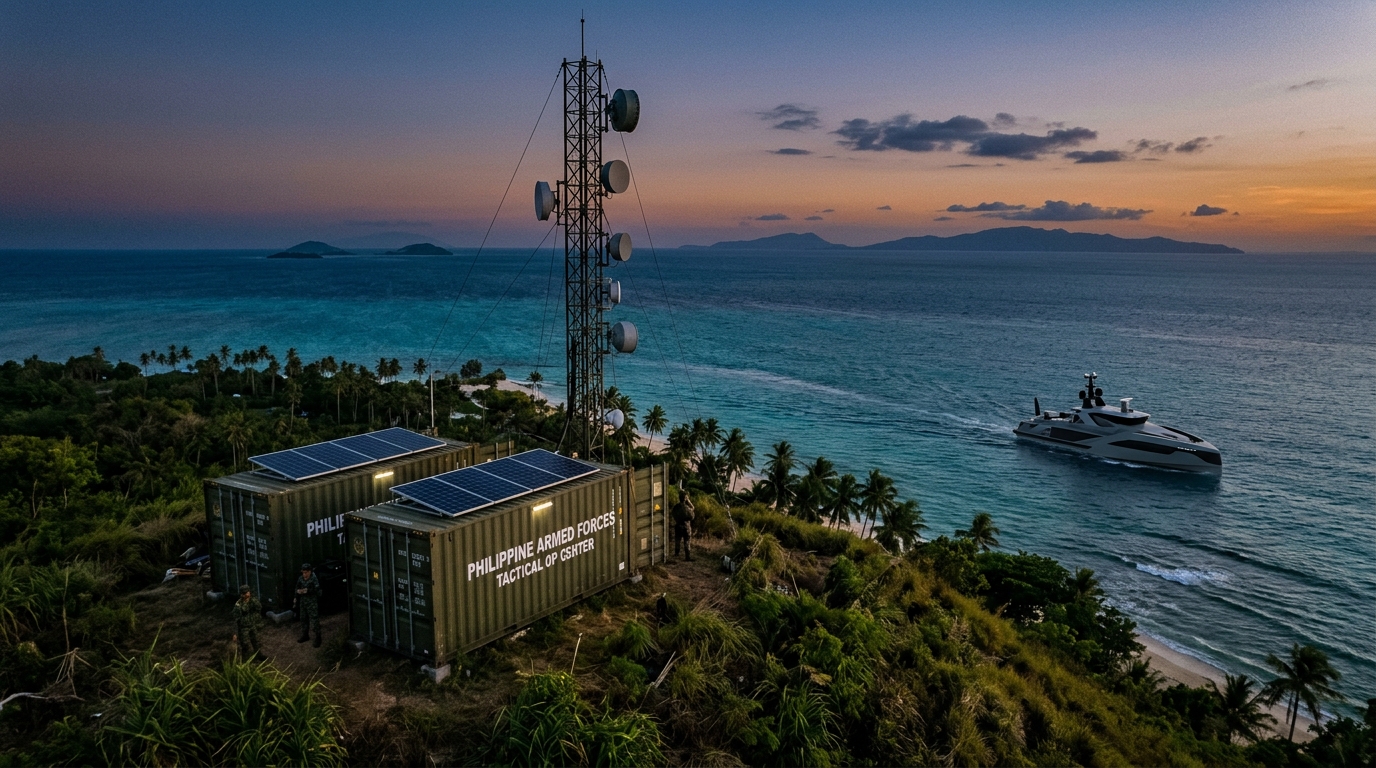
Un-Killable Topology
If international subsea cables are cut or metropolitan data centers are neutralized, the National Mesh seamlessly switches to Disaster Mode, routing packets across peer-to-peer microwave, mmWave, and dark-fiber paths without dropping local command and control.
Defense OPSEC & EW Immunity
Unlike commercial satellite internet (Starlink) or telco towers that emit identifiable signatures and can be geo-located or electronically jammed, distributed mesh nodes communicate over narrow-beam directional links and post-quantum WireGuard tunnels, masking troop movements.
Maritime Domain Awareness
Extending the mesh seaward turns fishing boats, lighthouses, and coastal outposts into distributed radar and acoustic hydrophone sensors, creating persistent surveillance across the Philippine Exclusive Economic Zone (EEZ).
Sovereign Cloud & The Asymmetric AI Doctrine
True resilience requires complete ownership of data storage and intelligence. The Philippines cannot purchase billions in Nvidia B200 clusters, but we can outmaneuver hyperscalers through compact models and agentic harnesses.
The On-Premise Sovereign Cloud
Self-healing enterprise file system with cryptographic bit-rot prevention, continuous replication, and immutable snapshots. Keeps institutional and defense data immune to cloud egress ransom.
Full sovereign suite replacing Google Workspace & Microsoft 365: private file sync, encrypted video calls, groupware, and document versioning hosted on local Philippine servers.
Standardizing on ISO-approved OpenDocument Format (ODF). Guarantees permanent access to legal, fiscal, and tactical documents without recurring software licensing taxes.
The Asymmetric AI Doctrine (4B–27B)
Rather than waiting for unattainable GPU superclusters, we deploy self-hosted open frontier models in the 4B to 27B parameter range (e.g. DeepSeek-R1-Distill, Qwen 2.5, Gemma 2) on commodity servers, older enterprise hardware, and edge NPUs.
Open Source Ecology: The Dual-Use Defense Flywheel
National defense is not purchased in a catalog—it is an emergent property of industrial manufacturing depth. A nation that can manufacture modular agricultural tractors, electric motors, and solar battery containers has already built the manufacturing lines for autonomous land drones and coastal defense vessels.

LifeTrac → Land Drones (UGVs)
The heavy-duty welded square-tubing chassis, modular hydraulic quick-couplers, and drive-by-wire controls designed for the LifeTrac tractor translate directly into autonomous logistics carriers, casualty evacuation platforms, and perimeter surveillance land drones for defense operations.
Solar Battery Containers (SBC)
The 1MW Solar Battery Container ("Power Plant in a Box") provides fuel-independent, silent electrical power. In peacetime, it electrifies off-grid farming communities; in wartime, it powers forward island radar installations and tactical command centers without relying on vulnerable diesel supply lines.
Coastal Drone Ships (USVs)
Rather than purchasing a handful of expensive foreign frigates, the Philippines can leverage local boatyards and open-source autonomous navigation to build fleets of uncrewed surface vessels (USVs). These agile craft provide continuous EEZ patrol, anti-poaching interdiction, and radar relay at a fraction of the cost.
The same industrial-depth logic applies to resource security: converting the country's own non-biodegradable waste stream into fuel, feedstock, and building-material bio-adhesive is a parallel import-substitution and resilience play, not a separate initiative.
Circular Economy & Green TechProject Balangay: Working Charter (Draft 0.1)
The formal engineering constitution guiding the development of the open-hardware router and switch. Assembled from silicon with mainline Linux support, on boards small enough for one engineer and a trusted fab to get right.
No SoC fanout, no DDR routing. A System-on-Module vendor has already done that work and validated it in volume.
If it requires a vendor SDK blob, it is off the list. A closed driver undoes the entire point of an open appliance.
Where the vendor publishes a reference schematic and stackup, copy it exactly. Deviation requires written justification.
The switch board (Board A) is 4-layer and sellable alone. Building it first qualifies the fab before risking the carrier.
Every performance claim gets proven on off-the-shelf hardware first. A PCB spin is a slow way to learn what an eval kit shows in a week.
Switch Silicon Shortlist (Ranked by Mainline Driver Support)
Chosen strictly for zero-blob upstream Linux kernel compatibility.
| Part Number | Ports | Mainline Driver | PH Sourcing | Strategic Assessment |
|---|---|---|---|---|
| Microchip KSZ9897 | 7 Gigabit | ksz • mature | Good | Default pick. Provides 5 front-panel ports plus CPU uplink with expansion headroom. |
| Microchip KSZ9893 | 3 Gigabit | ksz • mature | Good | Lowest risk. Right choice if a 3-port appliance satisfies first pilot deployments. |
| Realtek RTL8365MB | 5 Gigabit | rtl8365mb | Excellent | Cheapest landed cost; thinner feature set. Excellent high-volume second source. |
| Marvell 88E6xxx | Varies | mv88e6xxx | Difficult | Technically superior, but commercially high barrier without large-volume distributor contracts. |
Prove in Software
Buy CM3588 NAS kit and switch eval board. Build OpenWrt image, verify DSA driver throughput, and validate WireGuard crypto speed on off-the-shelf hardware before drawing PCB copper.
Board A: BGY-SW5
Spin 4-layer switch board with 5× RJ45 and integrated magnetics. Establishes toolchain, SMT assembly relationship, and QA soak testing. Two units must pass 40°C thermal soak.
Board B: BGY-CM1
Spin 6-layer carrier hosting CM3588 SoM, power tree, M.2 slots, and MAC link. Boots custom OpenWrt image from eMMC, controls Board A, and validates watchdog MCU.
Enclose & Certify
CNC aluminum enclosure, Bureau of Product Standards (BPS) and NTC compliance, repair manuals. Deploy 90-day pilot units in real Comfac client facilities and publish open BOM.
Collaborate on Philippine Sovereign Hardware
Discussion and open collaboration are ongoing in the BetterGov.ph ecosystem. Join the effort to manufacture, audit, and deploy resilient open hardware across the Philippines.